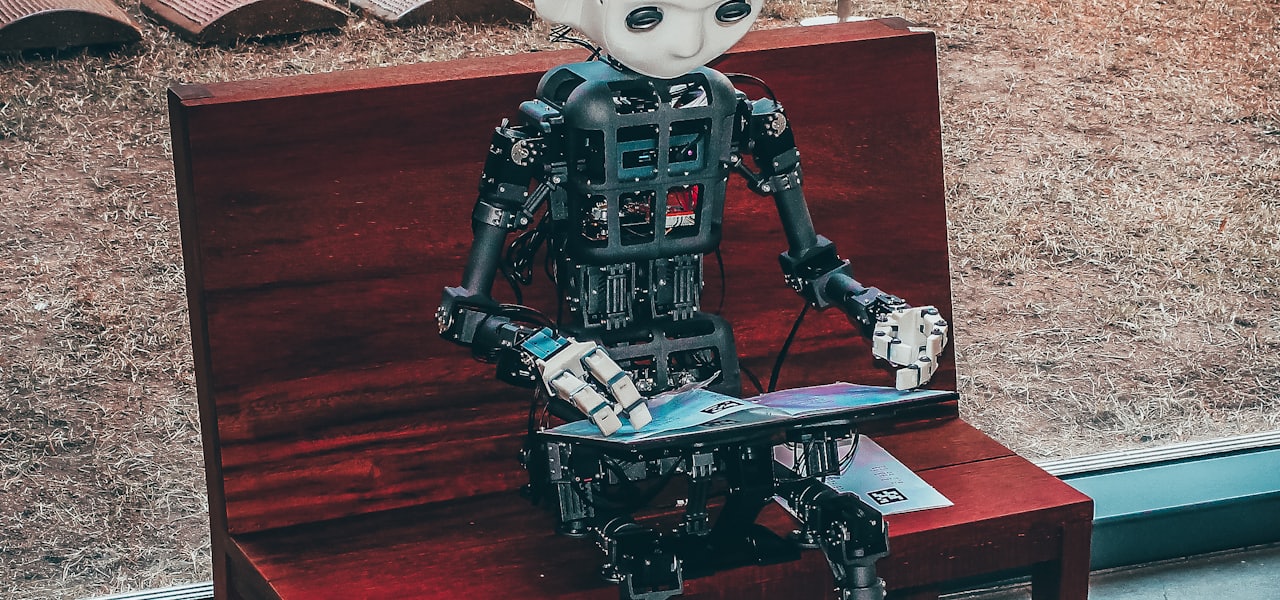
Autonomic computing (AC) is distributed computing resources with self-managing characteristics, adapting to unpredictable changes while hiding intrinsic complexity to operators and users. Initiated by IBM in 2001, this initiative ultimately aimed to develop computer systems capable of self-management, to overcome the rapidly growing complexity of computing systems management, and to reduce the barrier that complexity poses to further growth. == Description == The AC system concept is designed to make adaptive decisions, using high-level policies. It will constantly check and optimize its status and automatically adapt itself to changing conditions. An autonomic computing framework is composed of autonomic components (AC) interacting with each other. An AC can be modeled in terms of two main control schemes (local and global) with sensors (for self-monitoring), effectors (for self-adjustment), knowledge and planner/adapter for exploiting policies based on self- and environment awareness. This architecture is sometimes referred to as Monitor-Analyze-Plan-Execute (MAPE). Driven by such vision, a variety of architectural frameworks based on "self-regulating" autonomic components has been recently proposed. A similar trend has recently characterized significant research in the area of multi-agent systems. However, most of these approaches are typically conceived with centralized or cluster-based server architectures in mind and mostly address the need of reducing management costs rather than the need of enabling complex software systems or providing innovative services. Some autonomic systems involve mobile agents interacting via loosely coupled communication mechanisms. Autonomy-oriented computation is a paradigm proposed by Jiming Liu in 2001 that uses artificial systems imitating social animals' collective behaviours to solve difficult computational problems. For example, ant colony optimization could be studied in this paradigm. == Problem of growing complexity == Forecasts suggested that the computing devices in use would grow at 38% per year and the average complexity of each device was increasing. This volume and complexity was managed by highly skilled humans; but the demand for skilled IT personnel was already outstripping supply, with labour costs exceeding equipment costs by a ratio of up to 18:1. Computing systems have brought great benefits of speed and automation but there is now an overwhelming economic need to automate their maintenance. In a 2003 IEEE Computer article, Kephart and Chess warn that the dream of interconnectivity of computing systems and devices could become the "nightmare of pervasive computing" in which architects are unable to anticipate, design and maintain the complexity of interactions. They state the essence of autonomic computing is system self-management, freeing administrators from low-level task management while delivering better system behavior. A general problem of modern distributed computing systems is that their complexity, and in particular the complexity of their management, is becoming a significant limiting factor in their further development. Large companies and institutions are employing large-scale computer networks for communication and computation. The distributed applications running on these computer networks are diverse and deal with multiple tasks, ranging from internal control processes to presenting web content to customer support. Additionally, mobile computing is pervading these networks at an increasing speed: employees need to communicate with their companies while they are not in their office. They do so by using laptops, personal digital assistants, or mobile phones with diverse forms of wireless technologies to access their companies' data. This creates an enormous complexity in the overall computer network which is hard to control manually by human operators. Manual control is time-consuming, expensive, and error-prone. The manual effort needed to control a growing networked computer-system tends to increase quickly. 80% of such problems in infrastructure happen at the client specific application and database layer. Most 'autonomic' service providers guarantee only up to the basic plumbing layer (power, hardware, operating system, network and basic database parameters). == Characteristics of autonomic systems == A possible solution could be to enable modern, networked computing systems to manage themselves without direct human intervention. The Autonomic Computing Initiative (ACI) aims at providing the foundation for autonomic systems. It is inspired by the autonomic nervous system of the human body. This nervous system controls important bodily functions (e.g. respiration, heart rate, and blood pressure) without any conscious intervention. In a self-managing autonomic system, the human operator takes on a new role: instead of controlling the system directly, he/she defines general policies and rules that guide the self-management process. For this process, IBM defined the following four types of property referred to as self-star (also called self-, self-x, or auto-) properties. Self-configuration: Automatic configuration of components; Self-healing: Automatic discovery, and correction of faults; Self-optimization: Automatic monitoring and control of resources to ensure the optimal functioning with respect to the defined requirements; Self-protection: Proactive identification and protection from arbitrary attacks. Others such as Poslad and Nami and Sharifi have expanded on the set of self-star as follows: Self-regulation: A system that operates to maintain some parameter, e.g., Quality of service, within a reset range without external control; Self-learning: Systems use machine learning techniques such as unsupervised learning which does not require external control; Self-awareness (also called Self-inspection and Self-decision): System must know itself. It must know the extent of its own resources and the resources it links to. A system must be aware of its internal components and external links in order to control and manage them; Self-organization: System structure driven by physics-type models without explicit pressure or involvement from outside the system; Self-creation (also called Self-assembly, Self-replication): System driven by ecological and social type models without explicit pressure or involvement from outside the system. A system's members are self-motivated and self-driven, generating complexity and order in a creative response to a continuously changing strategic demand; Self-management (also called self-governance): A system that manages itself without external intervention. What is being managed can vary dependent on the system and application. Self -management also refers to a set of self-star processes such as autonomic computing rather than a single self-star process; Self-description (also called self-explanation or Self-representation): A system explains itself. It is capable of being understood (by humans) without further explanation. IBM has set forth eight conditions that define an autonomic system: The system must know itself in terms of what resources it has access to, what its capabilities and limitations are and how and why it is connected to other systems; be able to automatically configure and reconfigure itself depending on the changing computing environment; be able to optimize its performance to ensure the most efficient computing process; be able to work around encountered problems by either repairing itself or routing functions away from the trouble; detect, identify and protect itself against various types of attacks to maintain overall system security and integrity; adapt to its environment as it changes, interacting with neighboring systems and establishing communication protocols; rely on open standards and cannot exist in a proprietary environment; anticipate the demand on its resources while staying transparent to users. Even though the purpose and thus the behaviour of autonomic systems vary from system to system, every autonomic system should be able to exhibit a minimum set of properties to achieve its purpose: Automatic: This essentially means being able to self-control its internal functions and operations. As such, an autonomic system must be self-contained and able to start-up and operate without any manual intervention or external help. Again, the knowledge required to bootstrap the system (Know-how) must be inherent to the system. Adaptive: An autonomic system must be able to change its operation (i.e., its configuration, state and functions). This will allow the system to cope with temporal and spatial changes in its operational context either long term (environment customisation/optimisation) or short term (exceptional conditions such as malicious attacks, faults, etc.). Aware: An autonomic system must be able to monitor (sense) its operational context as well as its internal state in order to be able to asses
ISSCO Graphics
Integrated Software Systems Corporation (ISSCO), doing business as ISSCO Graphics, was an American software developer and publisher based in San Diego, California, and active from 1970 to 1986. They were best known for their enterprise graphics software packages, including Tellagraf, CueChart and Disspla. == History == ISSCO Graphics had considered acquiring Breakthrough Software, whose software focus involved PC DOS, as a means of getting into the PC arena, but backed off when Computer Associates made an offer to acquire ISSCO. By early 1987 it was reported that "Issco users breathe sigh of relief" that all was well. The ISSCO User's Group was founded in 1976. ISSCO, which was founded in 1970 by Peter Preuss, was acquired by Computer Associates in 1986. == Notable products == === Tellagraf === ISSCO's Tellagraf is an early software package designed to allow end-users to "turn out full color, professional quality charts" with initial results displayed on a screen, modified as needed, and then "a final 'hard-copy' can be made .. or made into 35mm color transparencies for projection onto a screen." Users of Tellagraf often had access to CueChart and Disspla software. Often computer sites having one had all three. Terminals with varying degrees of graphics, such as the DEC's VT100 and Tektronix's Tektronix 4xxx family of text and graphics terminals. were supported, and the software ran on popular computing platforms. Four years are important to Tellagraf's early history: 1978: ease of use 1980: graphic-artist quality 1982: introduction of CueChart, and recognition by IEEE. 1983: "quality graphics enters the mainstream of data processing with ..." Tellegraf was eventually acquired by Computer Associates and renamed CA-Tellegraf. SAS users found it helpful. Universities, research institutes and financial services firms were among early users. === Disspla === Disspla is a package of data plotting subroutines that can be used from high level languages. It was also acquired by Computer Associates. === Tellaplan === In 1983 ISSCO introduced Tellaplan, "a project planning, report and schedule charting system for Tell-A- Graf users in IBM MVS or CMS or Digital Equipment Corp. VAX computers" atop which they built "two visual project management software packages" three years later.
SIGINT Activity Designator
A SIGINT Activity Designator (or SIGAD) identifies a signals intelligence (SIGINT) line of collection activity associated with a signals collection station, such as a base or a ship. For example, the SIGAD for Menwith Hill in the UK is USD1000. SIGADs are used by the signals intelligence agencies of Australia, Canada, New Zealand, the United Kingdom, and the United States (the Five Eyes). There are several thousand SIGADs including the substation SIGADs denoted with a trailing alpha character. Several dozen of these are significant. The leaked Boundless Informant reporting screenshot showed that it summarized 504 active SIGADs during a 30-day period in March 2013. == General format == A SIGAD consists of five to eight case insensitive alphanumeric characters. It takes the general form of an alphanumeric designator normally composed of a two- or three-letter prefix followed by one to three numbers. Often a dash is used to separate the alphabetic and numeric characters in the primary part of the designator, but less frequently a space is used as a separator or the alphabetic and numeric characters are concatenated together. An additional alphabetic character can be added to denote a sub-designator for a subset of the primary unit, such as a detachment. Lastly, a numeric character can be added after the aforementioned alphabetic to provide for a sub-sub-designator. In the examples below an X represents an alphabetic character and an N represents a numeric character that are part of the primary designator. Likewise, an x represents an alphabetic character and an n represents a numeric character that are part of a sub-designator. Here are valid generalized examples of SIGADs: The first two characters show which country operates the particular SIGINT facility, which can be US for the United States, UK for the United Kingdom, CA for Canada, AU for Australia and NZ for New Zealand. A third letter shows what sort of staff runs the station. SIGADs beginning with US without a third letter are used for intercept facilities run by the NSA. == PRISM SIGAD == One prominent SIGAD as of April 2013 is US-984XN, with an unclassified codename of PRISM. It is "the number one source of raw intelligence used for NSA analytic reports" according to National Security Agency sources in a document leaked by Edward Snowden. The President's Daily Brief, an all-source intelligence product, cited SIGAD US-984XN as a source in 1,477 items in 2012. The U.S. government operates the PRISM electronic surveillance collection program through NSA's Special Source Operations, an alliance with trusted telecommunications providers. == SIGADs for spy ships == The declassified SIGAD for the USS Liberty (AGTR-5) was USN-855. The USS Liberty incident occurred on 8 June 1967, during the Six-Day War, when Israeli Air Force jet fighter aircraft and Israeli Navy motor torpedo boats attacked the USS Liberty in international waters. The USS Pueblo (AGER-2) was a technical research ship, which was boarded and captured by North Korean forces on 23 January 1968, in what is known as the Pueblo incident. The declassified SIGAD for the NSA Direct Support Unit (DSU) from the Naval Security Group (NSG) on the USS Pueblo patrol involved in the incident was USN-467Y. The USS Pueblo, which officially remains a commissioned vessel of the United States Navy, is the only ship of the U.S. Navy currently being held captive. == Vietnam War SIGADs == The following are the Vietnam War-era declassified SIGADs from inside South Vietnam during the period of 1969 to 1975: Some locations have multiple SIGADs due to different types of collection activities and/or collection at different times during the period. The SIGADs beginning with USA were operated by the United States Air Force's United States Air Force Security Service (USAFSS). The SIGADs beginning with USM were operated by the United States Army's Army Security Agency (ASA). Lastly, the SIGADs beginning with USN were operated by the United States Navy's Naval Security Group (NAVSECGRU). All three of these units have been merged into other units or inactivated. The above list consists of the higher-echelon SIGADs. It does not include the numerous miscellaneous and temporary detachments, or direction finding stations belonging to major units or sites unless that detachment or site was the only one stationed in South Vietnam. Many of the "dets" were short-lived, often formed to support ongoing MACV operations or forward deployments of combat operational or maneuver units. These detachments usually were designated by a letter suffix attached to the higher-echelon SIGAD such as "USM-633J," which was a detachment of the 372d Radio Research Company, USM-633, supporting the United States Army's 25th Infantry Division. === Supporting Southeast Asia SIGADs === The following declassified SIGADs were highly relevant to the Vietnam Campaign, but were located in areas outside of South Vietnam in Southeast Asia. Again, detachments are not listed separately. In the case of the USS Maddox, naval Direct Support Units (DSUs) used the SIGAD USN-467 as a generic designator for their missions. Each specific patrol received a letter suffix for its duration. The subsequent mission would receive the next letter in an alphabetic sequence. Thus, SIGAD USN-467N specifically designates the USS Maddox patrol involved with the Gulf of Tonkin incident. == Joint Base SIGADs == In November 2005, the US Congress performed a fifth round of Base Realignment and Closure. This 2005 law also created twelve joint bases by merging adjacent installations belonging to different services in an effort to reduce costs and improve efficiencies. Joint bases with a primarily SIGINT mission have SIGADs that begin with USJ. A joint base would have a primary SIGAD in the general form of USJ-NNN, where NNN are numeric characters. An actual example is not given, since these units are currently active.
Forking lemma
The forking lemma is any of a number of related lemmas in cryptography research. The lemma states that if an adversary (typically a probabilistic Turing machine), on inputs drawn from some distribution, produces an output that has some property with non-negligible probability, then with non-negligible probability, if the adversary is re-run on new inputs but with the same random tape, its second output will also have the property. This concept was first used by David Pointcheval and Jacques Stern in "Security proofs for signature schemes," published in the proceedings of Eurocrypt 1996. In their paper, the forking lemma is specified in terms of an adversary that attacks a digital signature scheme instantiated in the random oracle model. They show that if an adversary can forge a signature with non-negligible probability, then there is a non-negligible probability that the same adversary with the same random tape can create a second forgery in an attack with a different random oracle. The forking lemma was later generalized by Mihir Bellare and Gregory Neven. The forking lemma has been used and further generalized to prove the security of a variety of digital signature schemes and other random-oracle based cryptographic constructions. == Statement of the lemma == The generalized version of the lemma is stated as follows. Let A be a probabilistic algorithm, with inputs (x, h1, ..., hq; r) that outputs a pair (J, y), where r refers to the random tape of A (that is, the random choices A will make). Suppose further that IG is a probability distribution from which x is drawn, and that H is a set of size h from which each of the hi values are drawn according to the uniform distribution. Let acc be the probability that on inputs distributed as described, the J output by A is greater than or equal to 1. We can then define a "forking algorithm" FA that proceeds as follows, on input x: Pick a random tape r for A. Pick h1, ..., hq uniformly from H. Run A on input (x, h1, ..., hq; r) to produce (J, y). If J = 0, then return (0, 0, 0). Pick h'J, ..., h'q uniformly from H. Run A on input (x, h1, ..., hJ−1, h'J, ..., h'q; r) to produce (J', y'). If J' = J and hJ ≠ h'J then return (1, y, y'), otherwise, return (0, 0, 0). Let frk be the probability that FA outputs a triple starting with 1, given an input x chosen randomly from IG. Then frk ≥ acc ⋅ ( acc q − 1 h ) . {\displaystyle {\text{frk}}\geq {\text{acc}}\cdot \left({\frac {\text{acc}}{q}}-{\frac {1}{h}}\right).} === Intuition === The idea here is to think of A as running two times in related executions, where the process "forks" at a certain point, when some but not all of the input has been examined. In the alternate version, the remaining inputs are re-generated but are generated in the normal way. The point at which the process forks may be something we only want to decide later, possibly based on the behavior of A the first time around: this is why the lemma statement chooses the branching point (J) based on the output of A. The requirement that hJ ≠ h'J is a technical one required by many uses of the lemma. (Note that since both hJ and h'J are chosen randomly from H, then if h is large, as is usually the case, the probability of the two values not being distinct is extremely small.) === Example === For example, let A be an algorithm for breaking a digital signature scheme in the random oracle model. Then x would be the public parameters (including the public key) A is attacking, and hi would be the output of the random oracle on its ith distinct input. The forking lemma is of use when it would be possible, given two different random signatures of the same message, to solve some underlying hard problem. An adversary that forges once, however, gives rise to one that forges twice on the same message with non-negligible probability through the forking lemma. When A attempts to forge on a message m, we consider the output of A to be (J, y) where y is the forgery, and J is such that m was the Jth unique query to the random oracle (it may be assumed that A will query m at some point, if A is to be successful with non-negligible probability). (If A outputs an incorrect forgery, we consider the output to be (0, y).) By the forking lemma, the probability (frk) of obtaining two good forgeries y and y' on the same message but with different random oracle outputs (that is, with hJ ≠ h'J) is non-negligible when acc is also non-negligible. This allows us to prove that if the underlying hard problem is indeed hard, then no adversary can forge signatures. This is the essence of the proof given by Pointcheval and Stern for a modified ElGamal signature scheme against an adaptive adversary. == Known issues with application of forking lemma == The reduction provided by the forking lemma is not tight. Pointcheval and Stern proposed security arguments for Digital Signatures and Blind Signature using Forking Lemma. Claus P. Schnorr provided an attack on blind Schnorr signatures schemes, with more than p o l y l o g ( n ) {\displaystyle polylog(n)} concurrent executions (the case studied and proven secure by Pointcheval and Stern). A polynomial-time attack, for Ω ( n ) {\displaystyle \Omega (n)} concurrent executions, was shown in 2020 by Benhamouda, Lepoint, Raykova, and Orrù. Schnorr also suggested enhancements for securing blind signatures schemes based on discrete logarithm problem.
Trace zero cryptography
First proposed by Gerhard Frey in 1998, trace zero cryptography refers to the use of trace zero varieties (TZV) for cryptographic purpose. Trace zero varieties are subgroups of the divisor class group on a low genus hyperelliptic curve defined over a finite field. These groups can be used to establish asymmetric cryptography using the discrete logarithm problem as cryptographic primitive. Trace zero varieties feature a better scalar multiplication performance than elliptic curves. This allows fast arithmetic in these groups, which can speed up the calculations with a factor 3 compared with elliptic curves and hence speed up the cryptosystem. Another advantage is that for groups of cryptographically relevant size, the order of the group can simply be calculated using the characteristic polynomial of the Frobenius endomorphism. This is not the case, for example, in elliptic curve cryptography when the group of points of an elliptic curve over a prime field is used for cryptographic purpose. However, to represent an element of the trace zero variety more bits are needed compared with elements of elliptic or hyperelliptic curves. Another disadvantage is the fact that it is possible to reduce the security of the TZV of 1/6th of the bit length using cover attack. == Mathematical background == A hyperelliptic curve C of genus g over a prime field F q {\displaystyle \mathbb {F} _{q}} where q = pn (p prime) of odd characteristic is defined as C : y 2 + h ( x ) y = f ( x ) , {\displaystyle C:~y^{2}+h(x)y=f(x),} where f monic, deg(f) = 2g + 1 and deg(h) ≤ g. The curve has at least one F q {\displaystyle \mathbb {F} _{q}} -rational Weierstraßpoint. The Jacobian variety J C ( F q n ) {\displaystyle J_{C}(\mathbb {F} _{q^{n}})} of C is for all finite extension F q n {\displaystyle \mathbb {F} _{q^{n}}} isomorphic to the ideal class group Cl ( C / F q n ) {\displaystyle \operatorname {Cl} (C/\mathbb {F} _{q^{n}})} . With the Mumford's representation it is possible to represent the elements of J C ( F q n ) {\displaystyle J_{C}(\mathbb {F} _{q^{n}})} with a pair of polynomials [u, v], where u, v ∈ F q n [ x ] {\displaystyle \mathbb {F} _{q^{n}}[x]} . The Frobenius endomorphism σ is used on an element [u, v] of J C ( F q n ) {\displaystyle J_{C}(\mathbb {F} _{q^{n}})} to raise the power of each coefficient of that element to q: σ([u, v]) = [uq(x), vq(x)]. The characteristic polynomial of this endomorphism has the following form: χ ( T ) = T 2 g + a 1 T 2 g − 1 + ⋯ + a g T g + ⋯ + a 1 q g − 1 T + q g , {\displaystyle \chi (T)=T^{2g}+a_{1}T^{2g-1}+\cdots +a_{g}T^{g}+\cdots +a_{1}q^{g-1}T+q^{g},} where ai in Z {\displaystyle \mathbb {Z} } With the Hasse–Weil theorem it is possible to receive the group order of any extension field F q n {\displaystyle \mathbb {F} _{q^{n}}} by using the complex roots τi of χ(T): | J C ( F q n ) | = ∏ i = 1 2 g ( 1 − τ i n ) {\displaystyle |J_{C}(\mathbb {F} _{q^{n}})|=\prod _{i=1}^{2g}(1-\tau _{i}^{n})} Let D be an element of the J C ( F q n ) {\displaystyle J_{C}(\mathbb {F} _{q^{n}})} of C, then it is possible to define an endomorphism of J C ( F q n ) {\displaystyle J_{C}(\mathbb {F} _{q^{n}})} , the so-called trace of D: Tr ( D ) = ∑ i = 0 n − 1 σ i ( D ) = D + σ ( D ) + ⋯ + σ n − 1 ( D ) {\displaystyle \operatorname {Tr} (D)=\sum _{i=0}^{n-1}\sigma ^{i}(D)=D+\sigma (D)+\cdots +\sigma ^{n-1}(D)} Based on this endomorphism one can reduce the Jacobian variety to a subgroup G with the property, that every element is of trace zero: G = { D ∈ J C ( F q n ) | Tr ( D ) = 0 } , ( 0 neutral element in J C ( F q n ) {\displaystyle G=\{D\in J_{C}(\mathbb {F} _{q^{n}})~|~{\text{Tr}}(D)={\textbf {0}}\},~~~({\textbf {0}}{\text{ neutral element in }}J_{C}(\mathbb {F} _{q^{n}})} G is the kernel of the trace endomorphism and thus G is a group, the so-called trace zero (sub)variety (TZV) of J C ( F q n ) {\displaystyle J_{C}(\mathbb {F} _{q^{n}})} . The intersection of G and J C ( F q ) {\displaystyle J_{C}(\mathbb {F} _{q})} is produced by the n-torsion elements of J C ( F q ) {\displaystyle J_{C}(\mathbb {F} _{q})} . If the greatest common divisor gcd ( n , | J C ( F q ) | ) = 1 {\displaystyle \gcd(n,|J_{C}(\mathbb {F} _{q})|)=1} the intersection is empty and one can compute the group order of G: | G | = | J C ( F q n ) | | J C ( F q ) | = ∏ i = 1 2 g ( 1 − τ i n ) ∏ i = 1 2 g ( 1 − τ i ) {\displaystyle |G|={\dfrac {|J_{C}(\mathbb {F} _{q^{n}})|}{|J_{C}(\mathbb {F} _{q})|}}={\dfrac {\prod _{i=1}^{2g}(1-\tau _{i}^{n})}{\prod _{i=1}^{2g}(1-\tau _{i})}}} The actual group used in cryptographic applications is a subgroup G0 of G of a large prime order l. This group may be G itself. There exist three different cases of cryptographical relevance for TZV: g = 1, n = 3 g = 1, n = 5 g = 2, n = 3 == Arithmetic == The arithmetic used in the TZV group G0 based on the arithmetic for the whole group J C ( F q n ) {\displaystyle J_{C}(\mathbb {F} _{q^{n}})} , But it is possible to use the Frobenius endomorphism σ to speed up the scalar multiplication. This can be archived if G0 is generated by D of order l then σ(D) = sD, for some integers s. For the given cases of TZV s can be computed as follows, where ai come from the characteristic polynomial of the Frobenius endomorphism : For g = 1, n = 3: s = q − 1 1 − a 1 mod ℓ {\displaystyle s={\dfrac {q-1}{1-a_{1}}}{\bmod {\ell }}} For g = 1, n = 5: s = q 2 − q − a 1 2 q + a 1 q + 1 q − 2 a 1 q + a 1 3 − a 1 2 + a 1 − 1 mod ℓ {\displaystyle s={\dfrac {q^{2}-q-a_{1}^{2}q+a_{1}q+1}{q-2a_{1}q+a_{1}^{3}-a_{1}^{2}+a_{1}-1}}{\bmod {\ell }}} For g = 2, n = 3: s = − q 2 − a 2 + a 1 a 1 q − a 2 + 1 mod ℓ {\displaystyle s=-{\dfrac {q^{2}-a_{2}+a_{1}}{a_{1}q-a_{2}+1}}{\bmod {\ell }}} Knowing this, it is possible to replace any scalar multiplication mD (|m| ≤ l/2) with: m 0 D + m 1 σ ( D ) + ⋯ + m n − 1 σ n − 1 ( D ) , where m i = O ( ℓ 1 / ( n − 1 ) ) = O ( q g ) {\displaystyle m_{0}D+m_{1}\sigma (D)+\cdots +m_{n-1}\sigma ^{n-1}(D),~~~~{\text{where }}m_{i}=O(\ell ^{1/(n-1)})=O(q^{g})} With this trick the multiple scalar product can be reduced to about 1/(n − 1)th of doublings necessary for calculating mD, if the implied constants are small enough. == Security == The security of cryptographic systems based on trace zero subvarieties according to the results of the papers comparable to the security of hyper-elliptic curves of low genus g' over F p ′ {\displaystyle \mathbb {F} _{p'}} , where p' ~ (n − 1)(g/g' ) for |G| ~128 bits. For the cases where n = 3, g = 2 and n = 5, g = 1 it is possible to reduce the security for at most 6 bits, where |G| ~ 2256, because one can not be sure that G is contained in a Jacobian of a curve of genus 6. The security of curves of genus 4 for similar fields are far less secure. == Cover attack on a trace zero crypto-system == The attack published in shows, that the DLP in trace zero groups of genus 2 over finite fields of characteristic diverse than 2 or 3 and a field extension of degree 3 can be transformed into a DLP in a class group of degree 0 with genus of at most 6 over the base field. In this new class group the DLP can be attacked with the index calculus methods. This leads to a reduction of the bit length 1/6th.
Generative art
Generative art is post-conceptual art that has been created (in whole or in part) with the use of an autonomous system. An autonomous system in this context is generally one that is non-human and can independently determine features of an artwork that would otherwise require decisions made directly by the artist. In some cases the human creator may claim that the generative system represents their own artistic idea, and in others that the system takes on the role of the creator. "Generative art" often refers to algorithmic art (algorithmically determined computer generated artwork) and synthetic media (general term for any algorithmically generated media), but artists can also make generative art using systems of chemistry, biology, mechanics and robotics, smart materials, manual randomization, mathematics, data mapping, symmetry, and tiling. Generative algorithms, algorithms programmed to produce artistic works through predefined rules, stochastic methods, or procedural logic, often yielding dynamic, unique, and contextually adaptable outputs—are central to many of these practices. == History == The use of the word "generative" in the discussion of art has developed over time. The use of "Artificial DNA" defines a generative approach to art focused on the construction of a system able to generate unpredictable events, all with a recognizable common character. The use of autonomous systems, required by some contemporary definitions, focuses a generative approach where the controls are strongly reduced. This approach is also named "emergent". Margaret Boden and Ernest Edmonds have noted the use of the term "generative art" in the broad context of automated computer graphics in the 1960s, beginning with artwork exhibited by Georg Nees and Frieder Nake in 1965: A. Michael Noll did his initial computer art, combining randomness with order, in 1962, and exhibited it along with works by Bell Julesz in 1965. The terms "generative art" and "computer art" have been used in tandem, and more or less interchangeably, since the very earliest days. The first such exhibition showed the work of Nees in February 1965, which some claim was titled "Generative Computergrafik". While Nees does not himself remember, this was the title of his doctoral thesis published a few years later. The correct title of the first exhibition and catalog was "computer-grafik". "Generative art" and related terms was in common use by several other early computer artists around this time, including Manfred Mohr and Ken Knowlton. Vera Molnár (born 1924) is a French media artist of Hungarian origin. Molnar is widely considered to be a pioneer of generative art, and is also one of the first women to use computers in her art practice. The term "Generative Art" with the meaning of dynamic artwork-systems able to generate multiple artwork-events was clearly used the first time for the "Generative Art" conference in Milan in 1998. The term has also been used to describe geometric abstract art where simple elements are repeated, transformed, or varied to generate more complex forms. Thus defined, generative art was practiced by the Argentinian artists Eduardo Mac Entyre and Miguel Ángel Vidal in the late 1960s. In 1972 the Romanian-born Paul Neagu created the Generative Art Group in Britain. It was populated exclusively by Neagu using aliases such as "Hunsy Belmood" and "Edward Larsocchi". In 1972 Neagu gave a lecture titled 'Generative Art Forms' at the Queen's University, Belfast Festival. In 1970 the School of the Art Institute of Chicago created a department called Generative Systems. As described by Sonia Landy Sheridan the focus was on art practices using the then new technologies for the capture, inter-machine transfer, printing and transmission of images, as well as the exploration of the aspect of time in the transformation of image information. Also noteworthy is John Dunn, first a student and then a collaborator of Sheridan. In 1988 Clauser identified the aspect of systemic autonomy as a critical element in generative art: It should be evident from the above description of the evolution of generative art that process (or structuring) and change (or transformation) are among its most definitive features, and that these features and the very term 'generative' imply dynamic development and motion. (the result) is not a creation by the artist but rather the product of the generative process - a self-precipitating structure. In 1989 Celestino Soddu defined the Generative Design approach to Architecture and Town Design in his book Citta' Aleatorie. In 1989 Franke referred to "generative mathematics" as "the study of mathematical operations suitable for generating artistic images." From the mid-1990s Brian Eno popularized the terms generative music and generative systems, making a connection with earlier experimental music by Terry Riley, Steve Reich and Philip Glass. From the end of the 20th century, communities of generative artists, designers, musicians and theoreticians began to meet, forming cross-disciplinary perspectives. The first meeting about generative Art was in 1998, at the inaugural International Generative Art conference at Politecnico di Milano University, Italy. In Australia, the Iterate conference on generative systems in the electronic arts followed in 1999. On-line discussion has centered around the eu-gene mailing list, which began late 1999, and has hosted much of the debate which has defined the field. These activities have more recently been joined by the Generator.x conference in Berlin starting in 2005. In 2012 the new journal GASATHJ, Generative Art Science and Technology Hard Journal was founded by Celestino Soddu and Enrica Colabella jointing several generative artists and scientists in the editorial board. Some have argued that as a result of this engagement across disciplinary boundaries, the community has converged on a shared meaning of the term. As Boden and Edmonds put it in 2011: Today, the term "Generative Art" is still current within the relevant artistic community. Since 1998 a series of conferences have been held in Milan with that title (Generativeart.com), and Brian Eno has been influential in promoting and using generative art methods (Eno, 1996). Both in music and in visual art, the use of the term has now converged on work that has been produced by the activation of a set of rules and where the artist lets a computer system take over at least some of the decision-making (although, of course, the artist determines the rules). In the call of the Generative Art conferences in Milan (annually starting from 1998), the definition of Generative Art by Celestino Soddu: Generative Art is the idea realized as genetic code of artificial events, as construction of dynamic complex systems able to generate endless variations. Each Generative Project is a concept-software that works producing unique and non-repeatable events, like music or 3D Objects, as possible and manifold expressions of the generating idea strongly recognizable as a vision belonging to an artist / designer / musician / architect /mathematician. Discussion on the eu-gene mailing list was framed by the following definition by Adrian Ward from 1999: Generative art is a term given to work which stems from concentrating on the processes involved in producing an artwork, usually (although not strictly) automated by the use of a machine or computer, or by using mathematic or pragmatic instructions to define the rules by which such artworks are executed. A similar definition is provided by Philip Galanter: Generative art refers to any art practice where the artist creates a process, such as a set of natural language rules, a computer program, a machine, or other procedural invention, which is then set into motion with some degree of autonomy contributing to or resulting in a completed work of art. Around the 2020s, generative AI models learned to imitate the distinct style of particular authors. For example, a generative image model such as Stable Diffusion is able to model the stylistic characteristics of an artist like Pablo Picasso (including his particular brush strokes, use of colour, perspective, and so on), and a user can engineer a prompt such as "an astronaut riding a horse, by Picasso" to cause the model to generate a novel image applying the artist's style to an arbitrary subject. Generative image models have received significant backlash from artists who object to their style being imitated without their permission, arguing that this harms their ability to profit from their own work. The emergence of text-to-image generative AI systems has expanded debates over authorship, copyright, and artistic labor. The main issues in these debates include the eligibility of AI-generated outputs for copyright protection and the legal and ethical questions of using existing copyrighted works as training data for generative AI systems. == Types == === Music === Johann Kirnberger's Mu
Cambridge Semantics
Cambridge Semantics is a privately held company headquartered in Boston, Massachusetts with an office in San Diego, California. The company is an enterprise big data management and exploratory analytics software company. == History == Cambridge Semantics was founded in 2007 by Sean Martin, Lee Feigenbaum, Simon Martin, Rouben Meschian, Ben Szekely and Emmett Eldred who all previously worked at IBM's Advanced Technology Internet Group. In 2012, Cambridge Semantics appointed Chuck Pieper as chief executive. Pieper was previously at Credit Suisse. In January 2016, Cambridge Semantics acquired SPARQL City and its graph database intellectual property. On April 18, 2024, Altair Engineering acquired Cambridge Semantics. On 26 March 2025, Siemens announced the acquisition of Altair. == Products == Anzo Smart Data Lake uses Semantic Web Technologies. It allows IT departments and their business users to access data. AnzoGraph DB Graph database. AnzoGraph DB is a massively parallel processing (MPP) native graph database built for diverse data harmonization and analytics at scale (trillions of triples and more), speed and deep link insights. It is used for embedded analytics that require graph algorithms, graph views, named queries, aggregates, geospatial, built-in data science functions, data warehouse-style BI and reporting functions. It allows users to load and query RDF data using SPARQL or Cypher for OLAP-style analytics. == Marketing == Cambridge Semantics named SIIA Codie award 2018 finalist. Cambridge Semantics named 2018 Gold Stevie Award Winner for 'Big Data Solutions'. Cambridge Semantics named KMWorld’s 2018 ‘100 Companies That Matter in Knowledge Management’. Cambridge Semantics named to Database Trends and Applications' 'Trend-Setting Products in Data and Information Management for 2018'. Cambridge Semantics named to KMWorld Trend-Setting Products of 2017. Cambridge Semantics named to Database Trends and Applications 'DBTA 100: The Companies That Matter Most in Data'. Cambridge Semantics named SIIA Codie award 2017 winner for ‘Best Text Analytics and Semantic Technology Solution’. Cambridge Semantics named 2017 Silver Stevie Award Winner for 'Big Data Solutions'. Cambridge Semantics named KMWorld’s 2017 ‘100 Companies That Matter in Knowledge Management’. Cambridge Semantics named SIIA Codie award 2016 finalist. Cambridge Semantics named KMWorld’s 2016 ‘100 Companies That Matter in Knowledge Management’ and KMWorld Trend-Setting Products of 2015. Cambridge Semantics named 2016 Bio-IT World Best of Show People's Choice Award Contenders and 2015 Bio-IT best of show finalist. Anzo Insider Trading Investigation and Surveillance named 2015 CODiE Award finalist. Cambridge Semantics Selected as Finalist for 2014 MIT Sloan CIO Symposium's Innovation Showcase. Cambridge Semantics named SIIA CODiE Award 2014 finalist. Cambridge Semantics Win 2013 SIIA CODiE Award for best business intelligence and analytics solution. Cambridge Semantics wins KMWorld 2012 Promise Award. Cambridge Semantics wins Best of Show at 2012 Bio-IT World Conference.